I am beginning to write this blog at a time of profound global uncertainty. The economic and colonial forces that have shaped the last two hundred and fifty years of inequality have led us to an extremely fragile situation, threatening to plunge us into an economic, ecological, and social cataclysm unprecedented in the modern era. Today, more than ever, the horizon seems to be tilting toward a new world war and/or an economic collapse. Added to this is a climate crisis that threatens entire regions of the planet with increasingly extreme phenomena, as well as the impoverishment of the middle and lower classes, the education crisis and the accelerated transformations that artificial intelligence is introducing both in the labor market and in our daily lives. As Mark Fisher points out in Capitalist Realism (2008), it seems that our capacity to imagine other futures has been shut down. But is there really no way out of our situation?
I’m writing this as an invitation to reflect more deeply on the roots of our current situation. I want to step back, at least for a moment, from the tendency to describe, time and again, its most visible symptoms—the uncertainty, precariousness, fear, the sense of powerlessness—and instead turn our gaze toward the deeper causes that produce and sustain them. Only if we manage to understand those far-reaching forces, those historical structures that have shaped our present, can we hope to bring about real and lasting change. If we want change to be more than just a fleeting reaction (yes, we are “reacting” from both ends of the political spectrum, reacting to an increasingly unstable and complex world), we need to understand the patterns that have long been silently organizing our world.
Ideas and concepts are not eternal: they are born at a precise historical moment, respond to certain conditions and, sooner or later, must be revised. Their power depends precisely on their capacity to illuminate a particular situation, not on some supposed immutable validity. That is why I believe the notion of “capitalist realism,” so crucial for understanding an era, has begun to exhaust its critical power. What once allowed us to accurately name the closing of the political horizon and the naturalization of capitalism as the only possible world, now risks becoming a repeated formula, a category that no longer opens up thought but rather closes it off. Instead of helping us imagine solutions, it may end up fixing us once again with the diagnosis of impotence. And when an idea ceases to guide our understanding of the present and becomes an inherited truth that no longer questions itself, it also begins to become an obstacle to truly constructive reflection.
The purpose of this blog is to engage in dialogue with Fisher’s ideas, to expand them and also to update them. But to do so, I believe it is necessary to place them within a broader historical framework, one that is not limited to the political and economic history of our tradition, but also delves into the history of magic and religion, and their relation to our current problems. Only in this way is it possible to understand more deeply the contemporary forms of attention capture, belief production, and desire organization that have shaped our social reality.
I’ve decided to call this blog “Capitalist Unrealism” as a nod to Fisher, but also in reference to the term unrealpolitik that I coined in my book The Hounds of Actaeon (2020) as a parody of realpolitik—a set of political principles based on practical rather than moral or ideological considerations, championed by figures such as Henry Kissinger, Deng Xiaoping, and Lee Kwan Yew. We could define unrealpolitik as a way of doing politics based on practical considerations but wielding fictional or openly unreal arguments. Its rise in the West gained momentum with Trump’s first administration and the emergence of post-truth, and accelerated with the conspiranoia sparked by movements and hashtags such as QAnon and Pizzagate, and more recently with the Epstein files.1
On the other hand, in a vein similar to that proposed by Nick Butler and Bernadette Loacker in their essay “Capitalist Unrealism: Countering the Crisis of Critique and Imagination” (2022), My proposal of capitalist unrealism functions as an evolution of Fisher’s concept while also opposing his idea that it is easier to imagine the end of the world than the end of capitalism. I agree with Butler and Loacker that the main obstacle to imagining and building other possible futures lies in a “crisis of imagination” produced by the dominant social imaginary, within which capitalist realism operates as a force that limits our capacity to think and try out alternatives.
And yet, I also believe the problem lies elsewhere: “unrealism”—that is, the capacity to manufacture “unrealities”—is neither a secondary feature of capitalism nor a mere cultural effect, but one of its most pervasive forces. Rather than an accessory, it is the core from which capitalism organizes its power and its advantage over other economic and political systems. According to capitalist unrealism, the production of “unrealities” is the primary operation of capitalism, not a mere byproduct. More than an accessory, it is the core from which capitalism organizes its power and advantage over other economic and political systems. Advertising, public relations, the media, and social networks are not epiphenomena of this economic system; they are its central mechanism of power. Thus, while Butler and Loacker ask whether it is possible to “inject capitalism […] with a healthy dose of unreality” through imagination, my argument is that the unrealities concocted by capitalism are precisely what has impeded not only collective action but also a broader and deeper understanding of the power dynamics in which we find ourselves. These unrealities have functioned as an incredibly efficient tool of concealment and obfuscation. Our problem is thus, an excess of imagination on the part of the capitalist establishment and little to no imagination on our part. In the era of capitalist realism, it was still possible to imagine a shared space, albeit a weakened and privatized one, for social interaction. In our unrealist era, this social space has fragmented into multiple realities—and their algorithmic echoes and variations—completely eliminating the illusion, already faint in any case, of a life in community.
Fisher’s insistence on the contemporary difficulty of imagining, articulating, or sustaining an alternative to capitalism stems largely from the social and economic environment of the United Kingdom during the turn of the millennium. This bleak period in the political and social life of the British Isles, which would lead to the austerity measures following the 2008 crisis, was a direct consequence of the policies of Margaret Thatcher’s government (1979–1990), a period of deregulation that brought an end to the so-called “postwar consensus”—which for decades had maintained a welfare state, a nationalized industry, and a regulated economy throughout the United Kingdom—and led to the implementation of free-market policies, cuts to public spending, the privatization of much of the country’s social services, and union repression under the pretext of combating inflation.
It is this neoliberal environment—which would spread to varying degrees throughout the West in the decades that followed—that Fisher refers to when he speaks of capitalist realism as something that cannot be confined
to art or to the quasi-propagandistic way in which advertising functions. It is more like a pervasive atmosphere, conditioning not only the production of culture but also the regulation of work and education, and acting as a kind of invisible barrier constraining thought and action.2
This statement is true, but only to a certain extent. While capitalism imposes a pervasive atmosphere that acts as an impediment to thought and action, this is a trait that had been developing within the capitalist milieu long before the generalized implementation of neoliberalism. Moreover, contrary to Fisher’s argument, it is precisely in the quasi-propagandistic way in which advertising functions, that we find the origin of this atmosphere. To understand this, we must briefly go back to the late 19th century, when US society shifted from an economy of necessity to an economy of desire.
H.C. Binswanger in his book Money and Magic:
the subsistence economy is adapted to satisfying man’s physical needs, which are satiable. Its goals are therefore finite. The industrial economy, on the other had, is adapted to imaginary needs, which can be constantly expanded thorough man’s fantasy; these needs are insatiable.3
In the field of industrial economics, sustaining these insatiable and nominally infinite needs required a very specific approach. Since “mass production is profitable only if its rhythm can be maintained—that is, if it can continue to sell its product in steady or increasing quantity […] The result is that while, under the handicraft of the small unity system of production that was typical a century ago, demand created the supply, today supply must actively seek to create its corresponding demand.” More than the production of consumer goods, the true challenge of an economy of desire has always been, in the words of political philosopher Samuel Strauss, to produce the customers. This production of demand, consumption (and costumers) is only possible if it is accompanied by a robust production of reality.
It is precisely in the constant creation of demand that the atmosphere capitalism has been imposing since its industrial implementation in the early 20th century arises. The pervasive atmosphere that hinders thought and action described by Fisher, has been, from its very inception, an atmosphere of desire imposed on capitalist societies through advertising, and which later found various political and military uses within the media establishment. The fact that the above quote comes from the book Propaganda (1928) by Edward Bernays—Sigmund Freud’s nephew and the founder of the discipline of public relations—speaks volumes about the origin of this phenomenon. The atmosphere Fisher refers to is not something separate from advertising and dependent solely on economic forces; it is, in fact, a subset of this pervasive atmosphere of desire that has been cultivated by the media, first through advertising and public relations, and later as entire sectors of reality or reality bubbles (“narratives,” in contemporary parlance), whose magical origins I will discuss in the next entry.
One of the most striking examples of these “reality bubbles” is the one created by the Russian state media in response to the war in Ukraine. When the bombing of the Ukrainian city of Kharkiv began in early March 2022, Oleksandra, a twenty-five-year-old Russian woman, was taking shelter from the missiles in the bathroom of her apartment with her four dogs. She had been on the phone for hours trying to convince her mother, who lives in Moscow, that the Russian army had invaded her city and that it was being bombed by Russian missiles. “I didn’t want to scare my parents, but I started telling them directly that civilians and children are dying […] But even though they worry about me, they still say it probably happens only by accident, that the Russian army would never target civilians. That it’s Ukrainians who’re killing their own people.”4 According to Oleksandra, her mother simply repeats what she hears on Russian television, which described the invasion as a “special military operation” to demilitarize and denazify Ukraine. Oleksandra’s parents seem to understand “that some military action is happening here. But they say: ‘Russians came to liberate you. They won’t ruin anything, they won’t touch you. They’re only targeting military bases’.”5 Russian state media made no mention of the bombing of residential districts in Kharkiv or the deaths of civilians, and for months, most of the Russian population lived in an alternate reality in which, according to their government, there was no “war,” no “attacks,” and no “invasion” of Ukraine. These words, mind you, are banned by the Russian media regulatory body.
The problem with these alternate realities is that once they take root in the minds of people they are very difficult to eradicate. Which is why Fisher’s argument that we can only threaten capital realism if we show it “to be in some ways inconsistent or untenable; if, that is to say, capitalism’s ostensible ‘realism’ turns out to be nothing of the sort”6 has never worked. If anything, two Trump administrations have been more than enough to show that capitalism doesn’t care much about its status as reality, precisely because such realism has revealed itself as unrealistic. Fisher himself admits that “the role of capitalist ideology is not to make an explicit case for something in the way that propaganda does, but to conceal the fact that the operations of capital do not depend on any sort of subjectively assumed belief,”7 that is, that regardless of whether we believe or not, capitalist realism—and capitalist unrealism as well—work without the need of an ideology.
I agree with Fisher that whenever the status of capitalism as reality is threatened, it usually responds in two ways: with resignation (“yes, capitalism isn’t perfect, but it’s the best we’ve got”), or with denial (“no, capitalism has nothing to do with inequality or global warming”). Of these two responses, denial is perhaps the most insidious and paradigmatic of unrealism, since it does not limit itself to rejecting the existence of the problem: it also denies the very act of denying. After all, how could someone be denying something that doesn’t even exist? Denial thus produces a void in which arguments become irrefutable, and it is precisely through this crack in reality that unreality begins to seep it.
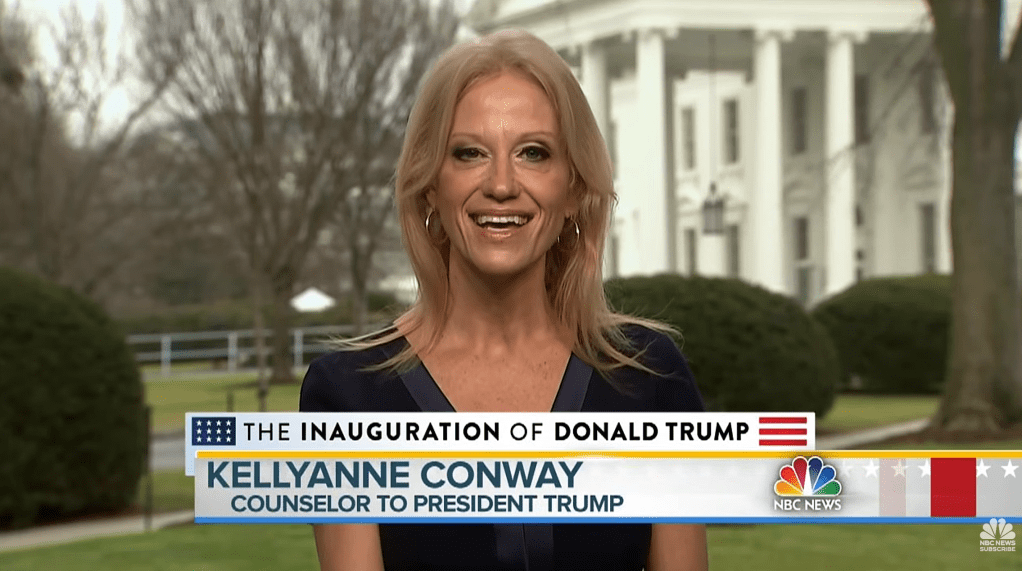
This absence of ideology is becoming increasingly evident and not even the concepts of “real,” “truth” or “fact” remain as common ground for society and discourse. To confirm this point, one only needs to recall how in early 2017 Trump counselor Kellyanne Conway talked on live TV of the “alternative facts”regarding the attendance number’s to Trump’s first inauguration as president. The absurdity of the statement (you only need to see the expression on Conway’s face) didn’t matter in the slightest, nor did it prevent the White House from continuing to issue more alternative facts, even when the interviewer confronted her, point blank, and said: “Look, alternative facts are not facts. They’re falsehoods.”
It is through a similar mechanism that Fisher understands the deep workings of capitalism: not only as an economic system, but as a perceptual regime sustained by continuous operations of negation, emptying and repudiation:
We believe that money is only a meaningless token of no intrinsic worth, yet we act as if it has a holy value. Moreover, this behavior precisely depends upon the prior disavowal – we are able to fetishize money in our actions only because we have already taken an ironic distance towards money in our heads.8
In these circumstances, every act of denial only brings more emptiness, more ironic distance, and more unreality. Whereas in a realist society hypocrisy designates the ability to feign beliefs, values or virtues that one does not actually possess, in an unrealist society a different skill becomes necessary, which I will call hypercrisy: the ability to pretend that one does not know what, deep down, it is known.
Perhaps the best example of this hypercrisy is the analog horror genre, in which it is not necessarily the content that produces horror, but rather the analog texture—a videotape with static, color test bars from a television station—that creates this effect. Thus, this genre does not produce terror through “reality” itself, through the content, but through “its representation.” For those born into hyperreality, the analog reveals that there is a base reality that has always been there but that they have never experienced. In this sense, hypercrisy does not simply consist of ignoring reality, but rather of living with the suspicion that a deeper layer of reality exists and, nevertheless, acting as if it had never existed.
Capitalism’s ability to generate “reality” through void and unreality, has been given various names over the past sixty years: Debord calls it the integrated spectacle; Baudrillard, simulacrum. For the former, in its integrated phase, “the spectacle has spread itself to the point where it now permeates all reality;”9 for the latter, the media have established a hyperreality, a televised subterfuge, which has ultimately absorbed war, to reveal its surgically altered face, “the cosmetically treated spectre of death.”10 The current phase of this development—let’s call it post-truth or unreality—was already becoming evident by 1988, when Debord spoke of “indisputable lies” as one of the distinctive characteristics of the integrated spectacle:
The simple fact of being unanswerable has given what is false an entirely new quality. At a stroke it is truth which has almost everywhere ceased to exist or, at best, has been reduced to the status of pure hypothesis. Unanswerable lies have succeeded in eliminating public opinion, which first lost the ability to make itself heard and then very quickly dissolved altogether.11
What “post-truth”, or “alternative facts”, or “unreality”ultimately mean is that truth has not only been eclipsed but that it is beginning to disappear as a relevant category with which we can grasp reality.
The refusal to admit what is known deep down, which characterizes hypercrisy, has led us to the opposite situation to that denounced by Baudrillard in The Gulf War Did Not Take Place. While at the end of the 20th century humans had developed “an obsessive fear of everything real, of any real event, of any real violence, of any enjoyment that is too real,”12 which led us to create enormous simulation devices; by the second decade of the 21st century, immersed in a world where it is almost impossible to distinguish reality from fiction, we are beginning to suffer an anxiety of the unreal. Is this true? Am I being lied to? Or is it a deepfake, a narrative manufactured with artificial intelligence? We know we live surrounded by unrealities, but we refuse to admit it openly.
In a détournement of the famous quote from Simulacra and Simulation, we could assert that:
It is the map, and not the real, whose vestiges persist here and there in the deserts that are no longer ours, but those of the Empire. The desert of the unreal itself.13
Hypercrisy, then, names the subjectivity characteristic of an era in which it is no longer enough to simulate, but rather it becomes necessary to manage the ontological uncertainty of everything that appears. We do not simply live surrounded by fictions: we live under the constant suspicion that reality itself has adopted the texture of a fiction. Unreality is no longer the negation of the real, but the very medium in which the real appears before us.
The absurdity of the unreality which we all inhabit is perfectly represented in a conversation in Barry Levinson’s comedy film Wag the Dog (1997). In it a spin doctor played by Robert De Niro and a Hollywood producer played by Dustin Hoffman are hired to create the “appearance of a war” with Albania to draw away the attention from accusations of sexual abuse on the part of the president (any resemblance to reality is a coincidence, the movie was released a month before the Clinton-Lewinsky scandal). Once their assignment is completed and a “peace agreement” is achieved, the characters talk about whether they should start a campaign to nominate the president for the Nobel Peace Prize:
“Well, if Kissinger can win the Peace Prize, I wouldn’t be surprised to wake up and find out I’d won the Preakness.”
“Well, yes, but our guy did bring peace.”
“Yeah, but there wasn’t a war.”
“All the greater accomplishment.”
* * *
The world in which some of the ideas that appear in Capitalist Realism were conceived is long gone and therefore they have lost much of their effectiveness as critical tools. Since the original publication of Fisher’s book in 2009, and his death in 2017, the world has gone through an epochal change. Thus, just as “in the 1980s, when [Fredric] Jameson first advanced his thesis about postmodernism, there were still, in name at least, political alternatives to capitalism” and by 2009, when Fisher wrote his book, these had given way to “a deeper, far more pervasive, sense of exhaustion, of cultural and political sterility,”14 by the 2020s, following the onset of surveillance capitalism, its development into a techno-feudalism, a pandemic, and the arrival of artificial intelligence, capitalism and politics themselves seem to be closing in on themselves and collapsing into their own sterility.
If, according to Fisher himself, capitalist realism can be subsumed under the rubric of postmodernism, then capitalist unrealism no longer belongs to that milieu. We are no longer in the postmodern condition, warns the Spanish philosopher Marina Garcés, but in another experience that she calls the posthumous condition.
In it, post- does not indicate what opens up after leaving the grand horizons and references of modernity behind. Our post- is what comes after the after: a post-posthumous post-, a period of extension we grant ourselves when we have already conceived and partly accepted the real possibility of our own end.15
In this atmosphere of paralysis, the neoliberal right—and its most recent manifestations, such as technofascism—continues to do (and accelerate) what it has done for the past seventy years: advancing a disastrous, dehumanizing socioeconomic model that is hostile to all life, which has devastated every society it has come into contact with, while proclaiming itself the only viable option even though it benefits only a tiny sector of the population;16 Meanwhile, the left, without having yet formulated a fully consistent political and economic alternative for the present, seeks to respond through economic policies and nationalization proposals that often refer to doctrinal frameworks of the past and that, in the face of the profound social and technological transformations of the last five decades, give the impression of not being entirely adjusted to contemporary reality. Inertia has taken hold of both camps. There are no real alternatives to the rampant unrealism of our time, which is why it is essential to think about options that go beyond our current political spectrum.
The idea that “it is easier to imagine the end of the world than the end of capitalism” is an excellent description of postmodernism’s and terminal capitalism’s dead ends; it is full of pathos, but it is highly debatable and depends entirely on how we define the end of the world. The mere phrase “end of the world” evokes images of nuclear and bacteriological war, economic and ecological collapse and, more recently, AI takeover. But the truth is that throughout this century we have lived through several ends of the world, we have renounced fulfillment and ideals, and we have learned to live in increasing uncertainty, precariousness and impotence, to live without a stable idea of future.
On the other hand, the problem with that assertion is that it rests on a false dichotomy. The end of capitalism would not simply amount to an absolute catastrophe, but to the end of a world: the world we know and in which most of us in the West have lived for the last two hundred years. More precisely, it would be the end of the Western world as we know it. Now, if the end of capitalism is the end of a world, the new world that succeeds it must not follow the parameters of the old world; therefore, it must not be based on politics as we know it today. In a world of increasing depoliticization through technology, the left must find a way out of the political world—understood as the sphere of relations based on the idea of polis—and must build new forms of collective engagement. To begin this task, we must urgently understand that both the left and the right are integral parts of this world, and we can only build a stable and lasting future outside of this agonistic and dualistic framework.
Now, if the idea of capitalist realism presents a fundamental weakness or bias, it can be located in the hauntological vein implicit in Fisher’s thought: the idea of lost futures, according to which the present is besieged by emancipatory possibilities that failed to materialize and yet persist as specters. These are, to a large extent, socialist or post-capitalist specters that continue to organize our imaginary within a restricted grammar of the possible: left or right, neoliberalism or socialism. These dyads have tended to confine political imagination within a dualistic scheme that makes it difficult to think about building the future outside of an antagonistic structure that, with different variations, has been reproduced throughout the religious and political history of the West. In that sense, our problem may not have been only the difficulty of imagining alternatives to capitalism, but also the fact that we have almost always tried to think about them within a traditional and agonistic political framework, governed by rules of the game that are already known and, therefore, easily co-opted or subverted by the system itself.
Rather than aspiring to a return to that lost future, we need to imagine a new architecture of possibility. The world has changed more in this century than since the postwar period, and we can no longer afford to continue thinking in the same terms and under the same frameworks. The global erosion of democracy, the depoliticization at the hands of a virulent alliance between the right and Silicon Valley and the rise of a fascistic technofeudalism are undeniable facts of our time. Our moment demands the creation of a different framework for thinking, imagining and building what is to come. It is not about recovering the unfinished promises of the past intact, but about creating the conditions for something to emerge that is no longer contained within the old ideological maps. Only from this deeper reorganization of the possible can the possibility of a genuinely new future germinate.
* * *
In the following posts I will endeavor to explain how we sank ourselves in this capitalist unreality and what are the historical and religious underpinnings of our situation. First, I will talk about the relation of erotic magic and gnosticism with capitalism, and then I will address how this all connects with the theopolitical superstructure that serves as the basis of the relations between culture and counterculture in Western civilization.
Lea esta publicación en español
- Until now, one of the most effective weapons of unrealpolitik has been conspiracy theories. Traditionally, these functioned as a tool for the underprivileged: they allowed them to construct their own narratives from which to denounce abuses of power. However, since phenomena like Pizzagate and QAnon, and even more evidently during the pandemic, this logic seems to have been reversed. Today, it is frequently the powerful who resort to spreading conspiracies to legitimize their interests and reinforce their worldview. This shift in strategy creates an environment in which the traditional narratives of the elites begin to intermix with other narratives that both reinforce and undermine their status as reality, creating a veritably unreal brand of politics. ↩︎
- Mark Fisher, Capitalist Realism, 23. ↩︎
- Binswanger, Money and Magic, 102. ↩︎
- Ukraine War: ‘My city’s being shelled but my Mum won’t believe me’. Disponible en: https://www.bbc.com/news/world-europe-60600487 ↩︎
- Ibid. ↩︎
- Fisher, op. cit., 23. In fact, in the same chapter Fisher himself argues that problems “environmental catastrophe features in late capitalist culture only as a kind of simulacra, its real implications for capitalism too traumatic to be assimilated into the system.” Rather than a supposed trauma, I would say that the force of the unrealities woven by capitalism overcomes the urgency of any “reality” that goes against it or challenges its economic priorities. ↩︎
- Ibid, 20. ↩︎
- Fisher, op. cit., 20-21 ↩︎
- Guy Debord, Comments on the Society of the Spectacle (London: Verso, 1998), 9. ↩︎
- Jean Baudrillard, The Gulf War Did Not Take Place, 28. ↩︎
- Debord, Comments on the Society of the Spectacle, 12-13. ↩︎
- Baudrillard,The Gulf War Did Not Take Place, 28. ↩︎
- The original quote reads: “It is the real, and not the map, whose vestiges persist here and there in the deserts that are no longer those of the Empire, but ours. The desert of the real itself.” (Baudrillard, Simulacra and Simulation, 1) ↩︎
- Fisher op. cit., 6 ↩︎
- Marina Garcés, Nueva ilustración radical, 16. My translation. ↩︎
- An excellent catalogue of the excesses and failures of neoliberalism is False Dawn: The Delusions of Global Capitalism (Granta, 1998), by the British philosopher John Gray. ↩︎
 Capitalist Unrealism
Leave a comment