
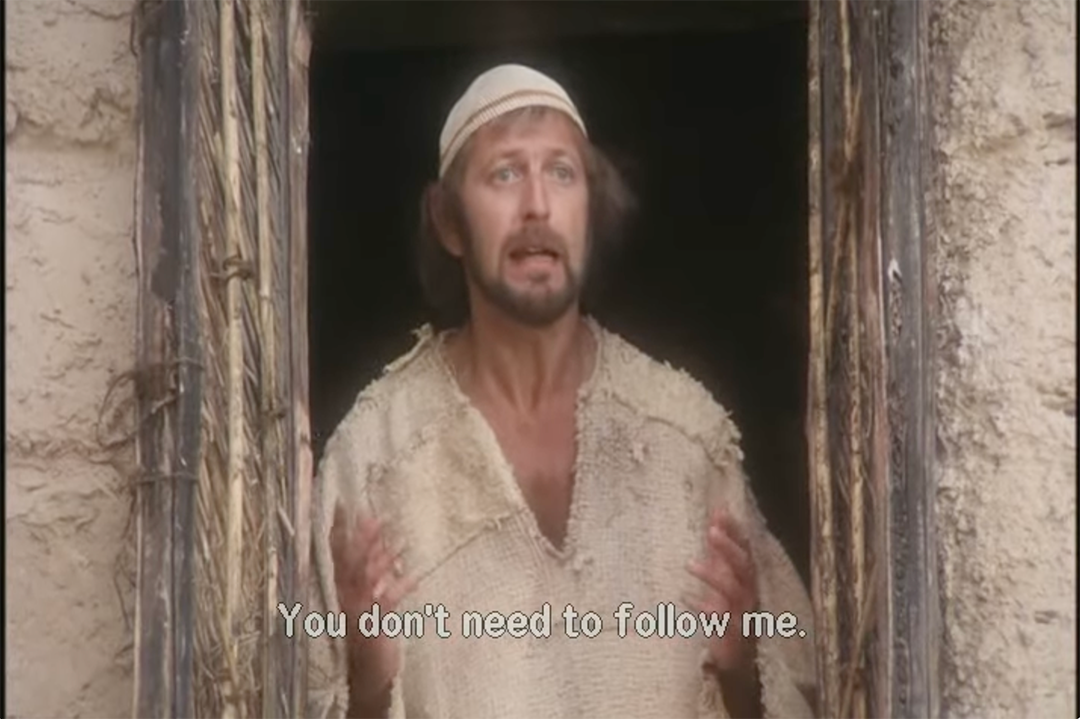
It all begins with a Gnostic impulse: the sense of being trapped in a reality that has ceased to function—a world that seems to be hurtling uncontrollably toward the abyss. This is an ancient intuition, yet one that has accelerated in our own times. Classical Gnosticism, too, was rooted in the suspicion that we inhabit a spurious, incomplete or outright false reality—and that, behind it, there must exist another form of truth capable of liberating us from this state. What changes throughout history is not so much this impulse to escape, but rather the destination toward which we imagine ourselves fleeing.
Moving beyond the unrealism of our era requires an examination of the historical forces and cycles that shaped terminal capitalism and, more broadly, the modern world. We have already taken some steps in this direction by tracing the gnostic and religious roots of Debord’s spectacle and demonstrating that modernity does not eliminate certain religious structures, but rather secularizes and redistributes them across the realms of politics, economics, science and technology. A more precise answer, however, requires looking further back to observe the dynamics that govern the relationship between establishment and counterculture, between orthodoxy and heresy. If there is one recurring pattern throughout Western history, it is that dominant forms of power periodically generate their own dissident responses—responses that, far from always existing outside the system, tend to be suppressed, absorbed or transformed until they themselves become new orthodoxies. Understanding this cycle is crucial, for the problem may not simply be how to escape the existing order, but rather how to ensure that any attempt at escape does not end up reproducing—through new symbols and new technologies—the very structure it sought to leave behind.
* * *
There are two profoundly magical ideas that remain hidden within the way we understand the modern world. The first is a teleological notion of progress—the belief that history is moving toward something, that it has a direction and, ultimately, a goal. This logic is present in many of the sociological, historical and economic theories that emerged during the nineteenth century and, according to some experts, even in certain ways of interpreting biological evolution. It matters little whether we are speaking of class struggle leading toward a new society, human history as a narrative with a discernible purpose, or a species becoming increasingly well-adapted to its environment. Behind all these images lies a similar structure: the end seems to be contained within the beginning; one simply needs to traverse the path that leads to it. One of the most persistent—and perhaps most difficult to detect—versions of this ancient, magical legacy appears today as determinism; it can even be found in one of the foundational assumptions of market economics, dating back to its modern formulation in the Victorian era.
John Gray on the subject:
The thinkers of the enlightenment, such as Thomas Jefferson, Tom Payne, John Stuart Mill and Karl Marx never doubted that the future for every nation in the world was to accept some version of western institutions and values. A diversity of cultures was not a permanent condition of human life. It was a stage on the way to a universal civilization. All such thinkers advocated the creation of a single worldwide civilization, in which the varied traditions and cultures of the past were superseded by a new, universal community founded on reason.1
Behind this vision of a universal society—“globalized,” in today’s terms—lies the idea that human societies evolve in a single direction: specifically, toward a form of market-regulated liberal democracy or, more recently, toward a techno-fascist totalitarianism that threatens to plunge us into an unprecedented ecological and economic collapse—let’s call it a new Middle Ages—or into an outright apocalypse.
Yet the magical dimension of the market economy does not end with this notion of teleology transformed into determinism. For the Swiss economist and philosopher Hans Christoph Binswanger, there is something more underlying the obsession of modern economics—and the market economy in particular—with unlimited growth: a secularized version of alchemy. That is to say, the promise of constantly transforming one thing into another, of generating more value from what already exists and of sustaining a process of expansion that, in theory at least, need never come to an end.
It is not vital to alchemy’s aim, in the sense of increasing wealth, that lead be actually transmuted into gold. It will suffice if a substance of no value is transformed into one of value: paper, for example, into money. We can interpret the economic process as alchemy if it is possible to arrive at money without having earned it through corresponding effort: if the economy is a top hat, so to speak, that yields a previously nonexistent rabbit: in other words, if a genuine value creation is possible which is not bound by any limits and is therefore, in this sense, sorcery or magic.2
This way of understanding the market economy finds a curious echo in George Soros. A couple of years after the publication of Binswanger’s book, the billionaire and financial speculator pointed out that if alchemy failed to “turn base metals into gold [it was] because the behavior of these metals is governed by laws of universal validity that cannot be altered by any statements, incantations, or rituals.” Economics, however, operates under different rules. Instead of metals and incantations, it involves people, institutions and markets—which, as Binswanger notes, are “easily influenced by theories and therefore highly susceptible to the methods of alchemy.” Thus, while alchemy failed as a science, economics may “succeed as alchemy.”3
Seen in this light, the problem is not merely that the modern world and modern science retain a premodern ferment; rather, it is that we have never truly left behind the magical and religious structures from which we supposedly liberated ourselves through the Enlightenment and modern science. Faith in progress, the alchemical promise of generating unlimited value and the belief in a market capable of spontaneously organizing the world are all components of a single apparatus with religious and esoteric roots. This is why—as we saw in the previous post—Guy Debord’s concept of “the spectacle” possesses a distinctly demiurgic dimension: capitalism no longer confines itself to producing commodities or managing the economy; instead, it manufactures the images, desires and narratives through which the world becomes intelligible.
In this sense, capitalism can also be thought of as a religion—and not merely because it possesses its own dogmas, rituals and promises of salvation. Capital itself reproduces something akin to the structure of a religious fetish: a human creation that ends up detaching itself from its creators, taking on the appearance of autonomy and ultimately imposing its own rules. Marx had already pointed to this inversion when discussing the fetishism of commodities: relationships between people appear as relationships between things, while those very things seem to come to life and exert an independent power over those who produce them. The market thus ceases to appear as an institution created and organized by human beings and begins to behave as an external, almost natural force, whose mandates we are simply compelled to obey.
Now, if capitalism occupies the place of a religious orthodoxy, this does not mean that Marxism does not follow the same script. Marxism is also a religious response—indeed, it is nothing less than its greatest heresy. It is, of course, a secularized heresy, yet one that does not entirely abandon the terrain of religion. Drawing on the work of authors such as Eric Voegelin and Ernst Topisch we can see that Marxism adopts a distinctly Gnostic structure: the existing world appears as a false and alienated order; there exists a form of knowledge (gnosis) capable of revealing the hidden forces that govern it; and history, through revolutionary transformation, leads toward the definitive overcoming of that alienation (salvation and escape). The proletariat thus occupies a privileged position within a drama of the Fall, revelation and redemption. Class struggle has always had a spiritual and religious dimension.
Capitalism and Marxism thus cease to be mere opposites and become two sides of the same coin; both can be understood as rival responses emerging from within the same religious imagination of history—competing over who should govern the world and how its salvation should be brought about. Thus, rather than having abandoned religion, it would seem that we are trapped in a much older dynamic. This is precisely the type of historical cycle that Morris Berman identifies in Coming to Our Senses: Body and Spirit in the Hidden History of the West: a history defined by recurring cycles in which a dominant orthodoxy generates its own heretical response—which it then either combats or ultimately absorbs—until a new orthodoxy takes its place and the process begins anew.
This historical cycle took shape during the period Karl Jaspers termed the Axial Age—an era of profound social, religious and philosophical transformation, spanning roughly the 8th to the 5th century BCE. Across various regions of Eurasia, this period saw the emergence of new ways of conceptualizing the relationship between human beings, the world and the transcendent. It was also during this major historical shift that deeply dualistic traditions began to take root in the West—such as Zoroastrianism and Zurvanism in Persia and, later, Platonism in Greece—in which reality was no longer viewed primarily as an interplay of complementary forces, but rather organized around increasingly stark oppositions: good and evil, spirit and matter, truth and appearance, this world and a higher, otherworldly realm. As Berman notes, these traditions “developed the notion of an Event (e.g., the coming of the Messiah) that would come along and close the gap between the mundane and the transcendent once and for all. In effect the mundane order will be destroyed; a notion not present in pre-Axial civilizations.”4
This shift carries enormous implications, as it introduces a radically different way of conceiving time: history ceases to be cyclical and begins to move toward a final resolution—toward the moment when one of the two poles will definitively triumph over the other. It is precisely at this juncture that duality—as opposed to the complementarity characteristic of many earlier mythical worldviews—begins to capture the Western imagination. Since then, much of our history can be interpreted as a series of variations on this very structure: a fallen or incomplete world, a truth capable of revealing it as such, an enemy that embodies what must be overcome and the promise of a future event that will ultimately resolve the contradiction.
The importance of the axial concept of the apocalypse—of a revelation that erupts to unveil the truth of the world and precipitate its conclusion—can hardly be overstated. More than a mere religious belief, it functions as one of the deep structures of the Western imagination—a kind of shadow that haunts the West and constantly drives it to transcend its current state. Wherever an incomplete order exists, there also emerges a fantasy of its revelation and transcendence; wherever there is history, there arises the expectation of an event capable of bringing it to a close. This shadow may take the form of the Last Judgment, a revolution, the end of history, a purifying catastrophe or a technological singularity, yet it is driven by the same underlying impulse: to reveal that the present world is not definitive and that, lying beyond it, another order awaits—one that can only emerge once the current order has been transformed or destroyed. In this sense, the apocalypse represents not only the Western fear of an end, but also a desire for transcendence: the persistent conviction that reality, as it currently exists, is never enough and must be steered toward something that surpasses it.
This point is of particular importance in our current historical moment and explains why much of the apocalyptic rhetoric that has resurfaced in politics today is less exceptional than it might appear. The biblical and eschatological language employed by figures such as JD Vance and Pete Hegseth, Peter Thiel’s obsession with the Antichrist, the growing influence of currents within religious Zionism that link sovereignty, redemption and the eventual reconstruction of the Third Temple and the alliance between certain American evangelical sectors and political Zionism all belong to the same theopolitical genealogy. In the case of Christian Zionism, this connection is explicitly tied to prophecy: the return of the Jews to Israel, the Battle of Armageddon and the Second Coming of Christ are presented as stages within a single eschatological sequence. Similarly, aspirations concerning a Third Temple—once relatively marginal—have gained increasing prominence within segments of Israeli religious Zionism. When these religious expectations become intertwined with territorial and military agendas—projects that are openly neocolonial and genocidal—what emerges is not merely a quaint survival of ancient prophecies, but rather the political continuity of the axial age imagination: the conviction that history is moving toward a definitive conclusion, that a specific people or agent is tasked with bringing it about and that the destruction of the existing order is a necessary precondition for the arrival of the world that will replace it.
To confirm this theopolitical climate, one need only watch a recent speech by Javier Milei in which the president of Argentina refers to Israel as the “bastion of the West” and suggests that if Israel were to fall, “they would then come for the entire West.” Who? Maybe the new hegemon rising in China, which benefits from every military and economic blunder perpetrated by Trump and Netanyahu? Or why not the so-called “cultural Marxism”—a far-right conspiracy theory positing that the left, upon realizing the world did not want a communist revolution, decided to infiltrate culture in order to corrupt people and their “Western” values?5 To top it off with a Manichaean note, Milei goes on to say that it is necessary to defend Israel because we are on the verge of waging “a battle between good and evil, between freedom and oppression, between civilization and barbarism.”6 A battle that, incidentally, he himself has exacerbated by impoverishing and polarizing his country’s population.
Broadly speaking, the psychological origin of these dualistic tendencies lies in the Neolithic period, when a clear division between the experience of self and other first emerged—a division that underpins sedentary developments such as agriculture and the domestication of animals. However, this duality was understood as a form of complementarity or polarity, which sustained relatively stable social and religious structures for millennia. It was only with the onset of the Axial Age that a significant portion of Western history began to unfold within an increasingly dualistic and oppositional dynamic—one characterized by the tension between culture and counterculture, orthodoxy and heresy. According to Berman, this cycle begins when a tradition—once rooted in a living spiritual experience—hardens into a rigid set of forms, rules and rituals stripped of their original meaning. The institutions tasked with managing the sacred become more concerned with preserving their own authority and reproducing their power structures than with keeping alive the very essence that once gave them purpose. At this stage, the dominant culture grows increasingly rigid and oppressive, while individuals find themselves bereft of a sense of meaning—a meaning they can no longer experience directly within their own bodies and lives.
It is here that emerges what Berman calls “gnostic response”: a movement of distancing or withdrawal from the established order—an attempt to reject and revitalize the exhausted forms of the dominant culture in order to recover a more immediate relationship with experience. Of course, it would be ludicrous to suggest that all Western heresies are continuations of ancient Gnosticism. Rather, what they share is a common sensibility: the feeling that the existing world has become false, alienating or spiritually uninhabitable, and that one must step away from it to gain access to a more authentic experience. Furthermore, this response retains a somatic, embodied dimension that orthodoxy tends to lose over time; in contrast to institutions that transform experience into doctrine, symbol or ritual, heresy seeks to return it to the body, to practice and to everyday life. Hence, throughout Western history, this response has manifested in forms as diverse as mysticism, asceticism, magic, heretical religious movements and even certain political and cultural movements that promise to reclaim what the dominant culture has repressed or allowed to wither away.
It is important to highlight that the dualistic structure that began to take shape during the Axial Age was not confined to religion or philosophy; it also became embedded in the fundamental matrix of Western politics. The word “politics” derives from polis, and for Aristotle, this is not merely the setting where human beings choose to live together, but the natural end toward which their earlier forms of association tend. Human beings, Aristotle argues, are by nature political animals (zōon politikon), and it is only within a community that they can fully realize their potential. Hence one of the most revealing assertions in his Politics: anyone who can live outside the polis, without needing others, must be “either a beast or a god.”7 This formulation establishes a radical boundary. In the middle lies the realm of the truly human—community, law, language, justice—while at the extremes appear two forms of exteriority: below, the animal, incapable of fully participating in the political order; above, the god, so self-sufficient that there is no need to do so.
The polis thus defines an “inside” and an “outside,” making membership in the political order a condition of humanity.8 Viewed through the cycle we have been describing, this separation reproduces the dualistic and exclusionary logic of the Axial Age: reality is organized around poles that define themselves—and acquire meaning—through opposition. From this perspective, much of Western political imagination can be read as a series of variations on this boundary: citizen and barbarian, believer and heretic, civilized and savage, revolutionary and reactionary, culture and counterculture. This is not to suggest that all such oppositions originate with Aristotle, but rather to recognize a recurring structure in which a political community must draw a line to determine who belongs to it—thereby simultaneously creating an outside. The problem is that this exterior rarely remains neutral; sooner or later, it becomes something that must be converted, incorporated, suppressed or defeated. Politics thus inherits the agonistic dynamic we observed in religion: an orthodoxy constructs its identity in opposition to its antithesis, while from its margins, a heretical response periodically emerges—an attempt to escape that orthodoxy which, all too often, ends up reproducing the very same oppositional structure it sought to transcend.
This same tendency to organize reality through mutually exclusive oppositions finds an especially powerful formulation in Aristotelian logic. Aristotle systematized principles that would later become known as the law of non-contradiction and the law of the excluded middle: a proposition cannot be both true and false at the same time, and between an assertion and its negation, there is no third, equivalent possibility, no grays. It would be an overstatement to claim that Western politics or religion derive directly from this logical structure; nonetheless, it is significant that a similar mode of thought reappears time and again in both spheres. The political community tends to be organized around the distinction between those who belong and those who are excluded; religious orthodoxy, around the divide between truth and error, salvation and damnation, devotion and heresy.
Whereas mythical thought could accommodate ambivalences, transformations and complementarities, axial imagination—and, subsequently, the Western philosophical tradition—developed an increasing discomfort with anything that occupies an intermediate position or participates simultaneously in opposing categories. The “third” becomes suspect: that which is neither clearly one thing nor the other must be classified, corrected or cast out. Viewed from this perspective, logic, politics and religion do not share a simple causal relationship, yet they all exhibit a common tendency to generate intelligible orders through sharp boundaries. The opposition between true and false thus finds echoes in the distinctions between citizen and foreigner, believer and infidel, orthodoxy and heresy; and the difficulty of conceiving a term that transcends both poles helps explain why so many countercultural responses ultimately do no more than invert the existing opposition, rather than abandoning it altogether.
Yet it is primarily from the overlap between politics and religion that what we might call the West’s theopolitical structure begins to take shape. In reality, the two spheres were never entirely separate: in the Greek polis, political, religious and cultural life were part of a single order, and citizenship defined who could fully participate in it and who remained on its margins. With the spread of Christianity, however, this political boundary encountered another, even more radical one inherited from the Axial Age: the separation between this world and the next, between salvation and damnation. The ancient distinction between those who belong to the community and those who remain outside began to take on a spiritual significance as well. It was no longer merely a matter of being inside or outside the city, but of finding oneself on the right or wrong side of a history moving toward its definitive resolution.
Late Roman Christianity offers one of the most powerful expressions of this structure. In the thought of Augustine of Hippo, for example, history is permeated by the opposition between the City of God and the earthly city—two communities defined by distinct destinies that will only be definitively separated at the end of time. Augustine, of course, does not simply equate these two cities with the Church and the State; yet, subsequent political tradition has repeatedly tended to project similar divisions onto concrete institutions and communities. The result is a political imagination in which belonging and truth begin to reinforce one another: every community requires an outside that circunscribes and defines it, and this outside can come to be perceived as heresy, impurity or threat. The exclusionary logic of the polis and the eschatological dualism of religion thus converge to fuel a single cultural structure—one capable of organizing the world through oppositions such as believer versus infidel, orthodox versus heretic, civilized versus barbarian and friend versus enemy. Long afterward—even when Western politics declared itself secular—this structure does not disappear. While the names of its poles may change, the temptation persists, on both sides, to divide reality between those who belong to the legitimate order and those who embody that which must be converted, disciplined, expelled or overcome.
At this point, the work of Carl Schmitt proves particularly useful. In Political Theology, Schmitt argues that “all significant concepts of the modern theory of the state are secularized theological concepts.”9 His argument is not merely that modern politics has borrowed certain religious vocabulary, but rather that many of its fundamental categories retain the same structure as ancient theological ideas. The sovereign, for instance, occupies a place within the political order comparable to that of God within the religious order: he is the one who guarantees the law, yet also the one who can suspend it when an exceptional situation arises. Hence the famous Schmittian definition: the sovereign is he who decides on the state of exception—a concept that bears a clear analogy to the theological miracle. Just as a miracle momentarily interrupts the laws of nature, the exception suspends the normal rules of the legal order.10 Viewed from this perspective, modernity does not eliminate the theopolitical structure we have been describing; instead, it translates and disguises it within a new language. God may vanish from the center stage, but sovereignty, the exception, historical salvation, orthodoxy and the enemy all persist in seemingly secular forms. Modern politics, therefore, does not necessarily break with axial imagination; rather, it continues to organize reality through the same oppositions: legitimacy and subversion, progress and bigotry, revolution and reaction. Thus, secularization does not dissolve this dualistic structure; it merely changes its terminology and embeds it within institutions that no longer need to present themselves as religious in order to continue functioning according to a profoundly theological logic.
If modernity does not entirely eliminate religious structures, but rather shifts them into the realms of politics, science, economics and the philosophy of history, then secularization should be understood less as a rupture and more as a transformation. Evidence for this lies in the fact that certain deep-seated ways of organizing experience—the opposition between a legitimate order and one that must be transcended, the promise of a future resolution, the periodic emergence of heresies in the face of ossified orthodoxies—continue to recur time and again. It is precisely from this perspective that the historical model Berman presents in Coming to our Senses gains traction: a series of cycles in which a dominant culture gradually loses its vitality, gives rise to a heretical response and ultimately either absorbs that response, suppresses it, or transforms it into a new orthodoxy.
The first of these cycles is what Berman calls the Greek model. In the Judeo-Hellenistic world of the early centuries of the Common Era, Christianity initially emerged as a Jewish messianic sect—a movement born within Second Temple Judaism, characterized by strong apocalyptic expectations and the belief that the Messiah’s arrival heralded a radical transformation of the existing order. Only gradually, as it expanded throughout the Hellenistic world, did this movement begin to distinguish itself from the Judaism that had given rise to it, incorporating and reinterpreting elements from mystery religions, Greek philosophy and various Gnostic currents. For Berman, this combination offered a more immediate and transformative experience of salvation compared to religious forms that were beginning to be perceived as overly institutionalized or detached from the direct experience of the sacred.
It is important to highlight that a movement such as Christianity would hardly have gained such strength outside the political and religious climate that preceded it. From approximately the middle of the second century BCE, the Jewish people endured a long period of foreign domination, revolts and repression—a period that would persist well into the Roman era. In this context, religion and politics became increasingly intertwined, while messianic and apocalyptic expectations intensified: in the face of a present defined by occupation and violence, the prospect of a liberator appearing to interrupt the normal course of history and establish a new order ceased to be a mere theological abstraction and instead became a collective hope.
For Berman, this situation created particularly fertile ground for movements that combined the expectation of an imminent historical transformation with direct, ecstatic and apocalyptic experiences of the divine. It was precisely here that Christianity found its expansive momentum: the figure of Jesus could be interpreted not only as the long-awaited Messiah, but as proof that the promised rupture had already begun and that salvation could be experienced in the here and now. Subsequent Roman persecution, far from extinguishing this energy, reinforced the separation between the new Christian community and the Judeo-Hellenistic world from which it emerged; meanwhile, its organizational capacity—especially under the influence of Paul—enabled the transformation of that apocalyptic expectation into a religious movement capable of sustaining itself, reproducing and spreading far beyond its original Jewish context.
Yet what began as a vital somatic and spiritual experience eventually turned into a church that sacrificed its original substance for the sake of influence and power within the Greco-Roman context. It is precisely at this juncture that the cycle in which we remain trapped becomes entrenched: that which emerges as a living, marginal and transformative experience ends up solidifying into an institution, a doctrine and an orthodoxy. Heresy triumphs, but in its triumph, it grows rigid. Christianity shifts from questioning the established order to becoming yet another orthodoxy, absorbing within itself many of the oppositions characteristic of the axial dualistic worldview—body and spirit, salvation and damnation, a fallen world and a redeemed one.
From this perspective, modern secularization does not represent an absolute break with that structure, but rather one of its subsequent transformations. Religious content may vanish or be translated into philosophical, political or economic terminology, yet the underlying structure persists: history remains oriented toward a final resolution; there exists a flawed order that must be transcended; and there invariably appears an agent capable of guiding us toward a higher form of existence. The Greek model thus inaugurates one of the core patterns of what Berman’s cycle: a rebellion against an orthodoxy ultimately gives rise to a new orthodoxy, which—albeit in a different guise—preserves the very same oppositional structure it sought to overcome.
The second phase of the cycle is what Berman calls the French model, the primary example of which is Catharism—a movement that flourished between the 11th and 13th centuries, particularly in the Occitan region of Languedoc. The Cathars were a Gnostic, strongly dualist sect; they distinguished between a benevolent spiritual principle and a corrupt or inferior material world, viewing salvation as the liberation of the soul from this material order. In contrast to a Church that was becoming increasingly powerful, hierarchical and intertwined with the feudal order, they offered a form of religiosity that was more austere, inward-looking and radical. For Berman, the significance lies not merely in Cathar doctrine itself, but in the fact that this heresy emerged as a response to the hardening of orthodoxy—an attempt to reclaim a direct spiritual experience in a context where the institution appeared to have been emptied of such substance.
Unlike early Christianity, Catharism never sought to become a new orthodoxy. Nevertheless, it was subjected to military persecution during the Albigensian Crusade, suppressed by the Inquisition—which was created expressly to eradicate it—and ultimately destroyed as an organized religious force. Yet the cycle does not simply end with its elimination. According to Berman, some of the spiritual and affective energy that had fueled this Gnostic heresy was absorbed by the dominant culture, reappearing in transformed ways within practices such as courtly love and certain forms of Marian devotion.11 The French model thus introduces a second possibility within the Western cycle: orthodoxy is not always replaced by heresy; it can also destroy heresy while simultaneously appropriating some of its elements, neutralizing them and incorporating them into its own lexicon. In this way, repression and absorption function as two sides of the same process. This capacity for the absorption and appropriation of countercultural elements would go on to become one of the most effective tactics of capitalist orthodoxy.
In fact, one of the two great modern systems of manipulation and control—the other being the magical system I described in the second post of this blog—can be traced back to the Inquisition, whose techniques strikingly anticipated certain features of contemporary totalitarian regimes. The systematic collection of testimonies, the creation of manuals for identifying and prosecuting heresy, the maintenance of archives, the tracking of suspects across vast territorial networks and the pressure exerted not only on the accused but also on their families constituted a genuine surveillance technology well before the technological age. As the historian Joseph Strayer observed, “Modern totalitarian governments have made few innovations; they have simply been more efficient.”12 From this perspective, modernity does not invent its repressive mechanisms from scratch; rather, it inherits pre-existing structures of surveillance, classification and persecution, amplifying them through bureaucracy, state centralization and, more recently, technological development.
Perhaps the most revealing aspect of the French model is that Catharism and Catholicism—despite presenting themselves as irreconcilable enemies—retain a surprisingly similar structure. Both are rooted in a profoundly dualistic worldview; both harbor a distrust of the body and the material realm; both conceive of earthly existence as a degraded state; and both locate salvation within a transcendent sphere that demands discipline, purification and renunciation. Thus, heresy does not entirely break with the logic of orthodoxy; rather, it mirrors and radicalizes it. In this sense, Catharism emerges as a kind of dark twin to Christianity: it rejects the latter’s hierarchies and sacraments, yet shares much of its spiritual grammar—the same distinction between the high and the low, the pure and the impure, the spirit and the flesh. It is almost a mirror image. Each defines its identity in opposition to the other, yet both remain trapped within the same dualistic framework that organizes reality through opposition and exclusion. This is why the conflict between orthodoxy and heresy can be so fierce: it is not a clash between two entirely distinct worlds, but rather between two rival versions of the same underlying structure. Heresy presents itself as a way out, yet it frequently ends up reproducing the very mechanism it sought to deny.
The third phase of the cycle is what Berman calls the Italian model, centered on the Hermetic magic of the Renaissance and its subsequent transformation into modern science. Broadly speaking, Renaissance Hermeticism conceived of the cosmos as a living totality, permeated by correspondences and hidden forces that connected human beings to the stars, nature and the spiritual realm. For figures such as Marsilio Ficino, Pico della Mirandola or Giordano Bruno, understanding these relationships did not merely entail contemplating them; the magician could intervene in them—using astrology, alchemy, imagery, talismans or the manipulation of natural sympathies—to actively participate in the transformation of the world. Rather than simply suppressing this heretical current—as the Catholic Church had previously done with the Cathars—nascent modernity absorbed part of the operative impulse of magic and paganism, transforming it from within. The magical desire to understand the secret forces of nature in order to act upon them persists, yet it gradually loses its participatory, spiritual and somatic dimensions: qualitative correspondences are replaced by quantifiable relationships, the living cosmos becomes an objectifiable nature, and the magician gives way to the scientist and the technician.
This shift becomes understandable when we consider the growing disenchantment that, by the fifteenth century, had begun to surround the dominant scholastic thought. The Christianized Aristotelianism of the medieval universities—closely tied to ecclesiastical authority—came to be perceived by some humanists as an excessively abstract, verbal and passive form of knowledge: a system more concerned with classifying and commenting upon the world than with intervening in it. In contrast to this tradition, Hermetic magic offered something radically different: an operative philosophy that promised not only to understand the forces of nature but to harness them. The appeal of the Renaissance magus lay precisely in this: he was no longer merely a spectator of a pre-ordered cosmos, but an agent capable of acting upon its correspondences, altering its balances and participating actively in the creation of reality.
Magic does not disappear, rather, it is inverted and abstracted. Its operative impulse—the aspiration to intervene in the forces of nature and transform them—survives, but its nature shifts: whereas the magician sought to participate in a living cosmos through correspondences, sympathies and qualitative bonds, modern science separates the observer from the observed, translates those relationships into magnitudes and general laws and turns intervention into a reproducible technical procedure. What once sought to participate in a living nature ends up becoming a method for observing it from the outside, predicting it and subjecting it to increasingly precise operations. For Berman, the Scientific Revolution represents a particularly radical form of secularization and disenchantment: the new science retains the transformative ambition of Hermetic magic while rejecting the spiritual universe that originally gave it meaning. Thus, heresy permeates and becomes orthodoxy once more, but this time in a form that no longer appears religious and that eventually presents itself as the definitive transcendence of the very magic that helped shape it.
The modern transformation of magic does not end with science. Once nature has been turned into an object of calculation, extraction and domination, that same logic goes on to organize the economy—and, with it, the entirety of social life. Capitalism takes up the old alchemical aspiration of producing unlimited growth and transforms it into a permanent principle of accumulation: everything can become a commodity, everything can be translated into value and all value must re-enter circulation to generate further value. In this new, secularized cosmos, the market begins to occupy a position comparable to that once held by the anima mundi—an invisible force that permeates and connects all things, coordinates actions across distances and appears to endow the whole with an intelligence of its own. Yet, unlike the anima mundi of the Renaissance, this new force no longer unites human beings with a living nature; instead, it reorganizes nature, labor, desire and imagination within a single circuit of commodified equivalences.
Although Berman does not explicitly formulate it in Coming to our Senses, his framework allows us to conceive of the emergence of a new phase in this historical cycle: let us call it the Californian model. Silicon Valley reproduces several of the characteristics that Berman identifies in ancient Western heresies: it arises from cultural margins, draws upon countercultural and spiritual currents, challenges the prevailing orthodoxy and, over time, eventually becomes a new orthodoxy itself. In this process, certain core features of the Gnostic response also reappear: a radical dualism between body and mind, a distrust of the limitations of the material condition and the promise of a future transcendence. In transhumanism in particular this structure takes on a technological form: salvation no longer consists of escaping the world for a spiritual realm, but rather of transcending the biological body through genetic engineering, radical life extension, or the eventual transfer of the mind onto digital substrates. The ancient divide between heaven and earth—between the mundane and the transcendent—thus reappears as a separation between mind and body, information and matter, intelligence and biology.
The resemblance to earlier cycles becomes even more evident when considering Silicon Valley’s countercultural origins.13 Like early Christianity or Renaissance Hermetic magic, California’s technological culture emerged in a heterodox environment, absorbing elements from the hippie movement, Eastern religions, esotericism, New Thought, cybernetics and libertarian philosophies. Yet, as with the Italian model, much of that energy was progressively abstracted, operationalized and harnessed to serve a new power structure. Berman terms this capacity of the scientific and corporate establishment—to appropriate the insights of holistic movements, strip them of their critical or spiritual dimension, and present them back to the public in a legitimized, domesticated and marketable form—cybernetic holism.
Thus, the Californian model represents the most recent phase of this cycle: a counterculture that, after promising to liberate us from dominant structures, ends up becoming one of the primary frameworks through which economic, technological and cultural power is organized. Yet history does not progress through simple substitution, but rather through accumulation. Modern technology—heir to Renaissance magic, first abstracted by science and subsequently reified into digital systems—also incorporates the project of surveillance, classification and control that began to take shape with the Inquisition. The new technological orthodoxy thus brings together two genealogies that once appeared distinct: the magical ambition to intervene in reality, and the institutional drive to render populations predictable and manipulable. The result is an infrastructure of power capable not only of observing and managing social life, but of anticipating it, modulating it and producing the very environments within which that life acquires meaning—thereby opening the possibility for a specifically digital form of totalitarianism.
And yet, the essence of the historical cycle remains intact. Where eschatological religions promised an event capable of closing, once and for all, the gap between the human and the divine, transhumanism envisions the technological singularity as a rupture point destined to transcend the limitations of our biological condition. As presented—albeit with considerable differences—by authors such as Ray Kurzweil and Nick Land, the singularity can be interpreted as a techno-capitalist version of the apocalypse: an irreversible event that divides history into a before and an after, promising to usher in a radically different form of existence. It is no longer God who breaks into history to redeem it, but a superior intelligence produced by technology itself; the expectation is no longer the resurrection of the body, but its transcendence, redesign, or even abandonment.
In this secularized form, the ancient, axial impulse to definitively close the gap between the transcendent and the immanent reappears. Yet, as happens time and again within this historical cycle, the attempt to abolish this separation only serves to deepen it. What manifests in Zoroastrianism as an opposition between good and evil, and in Manichaeism as a conflict between light and darkness, resurfaces in singularist philosophies as a fracture between intelligence and body, between technological evolution and biological nature. These new apocalypses no longer herald the end of the world through divine intervention, but rather the end of the human as we know it—a salvation promised precisely through our own obsolescence.
However, something different seems to be happening this time. The West no longer merely imagines its own apocalypses; it has acquired the technical means to bring them about. On one hand, the singularity—whether in its transhumanist, Landian, or AI-centered iterations—retains the old eschatological promise of an event capable of cleaving history in two and opening the gates to a radically new reality. On the other, the prospect of nuclear holocaust, ecological catastrophe or political interpretations of prophecies surrounding the Third Temple demonstrates that the end of the world is no longer confined exclusively to the realm of religious imagination.
In this context, Nick Land’s idea that capitalism can be conceived as an artificial intelligence constructing itself retrospectively from the future is particularly interesting. Although provocative, the idea is ontologically hard to sustain and, nevertheless, as an epistemological tool, it allows us to envision capital as an impersonal process that utilizes human beings, institutions and technology to accelerate its own reproduction. Yet perhaps Land’s formulation that best aligns with our current situation appears in his essay “Making It with Death,” where he asserts that capital is a “social suicide machine”: destruction would not constitute an accident external to the capitalist process, but rather a possibility inscribed within its very dynamic of expansion.
Seen thus, seemingly opposing versions of the contemporary apocalypse begin to appear strangely close. Both those who literally await a final conflagration to fulfill prophecy and those who celebrate a techno-capitalist singularity that would render humanity obsolete participate in a kind of spiritual accelerationism: an impatience to force the event and throw open, once and for all, the gates of the Kingdom—whatever that may mean. What is truly unsettling here is that the age-old, foundational impulse to bridge the gap between the transcendent and the immanent now has at its disposal tools capable of turning the apocalyptic metaphor into a material possibility.
Of course, we can “choose” to remain in this vicious cycle—in this dualistic trap of false revelation and redemption that has brought us to the brink of the end of the world—or we can choose to step out into a new reality, into the unmapped territory that lies beyond the oppositions that the theopolitical structure of the West has presented to us as unavoidable and inescapable.
* * *
In the next post, we will revisit the Californian model—this time to examine, in greater detail, its affinities with classical fascism, neoreaction, and other contemporary forms of the far right. However, the focus of our inquiry will shift: if Western history has been trapped for centuries in a succession of orthodoxies and heresies that ultimately reproduce the same dualistic architecture of opposition, then the task is no longer merely to imagine a new counterculture, but to conceive of a form of heresy that does not need to become its own inverted reflection. In other words, we will attempt to chart an escape route from the theopolitical structure of the West, rather than once again occupying one of its poles.
- John Gray, False Dawn, The Delusions of Global Capitalism (New York: The New Press, 1998), 2. ↩︎
- Hans-Christoph Binswanger, Money and Magic: The Modern Economy as an Alchemical Process (London: Quantum Publishers, 2016), 12. ↩︎
- Soros quoted by Binswanger. vii. ↩︎
- Morris Berman, Wandering god: a study in nomadic spirituality (Vermont: Echo Points Books & Media, 1989), 144. ↩︎
- Sven Lütticken, “Cultural Marxists like Us”, disponible en: https://svenlutticken.org/wp-content/uploads/2019/02/7002483.pdf ↩︎
- https://youtube.com/shorts/YzqiqWUkL-c?si=j5eDgnbZYHh7kZui ↩︎
- Aristotle, Polítics, I, 2, 1253a27-29 ↩︎
- It is worth noting that the modern category of “humanity”—understood as a universal condition shared by all individuals and as the foundation for moral or legal equality—cannot simply be projected onto ancient Greece. Nevertheless, the polis did establish a logic of belonging and exclusion that was markedly dualistic: citizen/foreigner, Greek/barbarian, free/slave, inside/outside. In this sense, rather than determining who was or was not “human” in modern terms, the Greek political order established the conditions under which a life could be recognized as fully political, civilized and capable of exercising those faculties considered to be properly human. ↩︎
- Carl Schmitt, Political Theology: Four Chapters on the Concept of Sovereignty, trans. George Schwab (Chicago: University of Chicago Press, 2005), 36. ↩︎
- Ibid. ↩︎
- One of the shrewdest responses of the Catholic Church to the Cathar threat was the institution of the cult of the Virgin Mary, dating from this time. In Love in the Western World Denis de Rougemont argues the eminent wisdom that the clergy which “sought to satisfy by ‘orthodox’ means was the human craving that had produced the symbolical cult of Woman. From the middle of the twelfth century onwards there was a succession of attempts to promote a cult of the Virgin. It was sought to substitute ‘Our Lady’ for the ‘Lady of Thoughts’ of the heretics. At Lyons in 1140 the canons instituted a Feast for the Immaculate Conception of Our Lady. And the monastic orders which sprang up at this time were replicas of the orders of knighthood” (de Rougemont, Love in the Western World, 85). ↩︎
- Joseph Strayer, The Albigesian Crusades (Ann Arbor: The University of Michigan Press, 1992), iv. ↩︎
- For more on this topic the reader can refer to From Counterculture to Cyberculture: Stewart Brand, the Whole Earth network, and the rise of digital utopianism by Fred Turner (University of Chicago Press, 2006), and What the Dormouse Said: How the Sixties Counterculture Shaped the Personal Computer Industry by John Markoff (Viking Press, 2005). ↩︎
Leave a Reply